

How To Do Pitru Tarpan At Home
Contents
1. Terminology of Shraddha
2. Tarpanand Pitru tarpan
2.1 Tarpan
1. Significance and meaning
two. Objective
3. Types
4. Method of performing Tarpan
2.2. Pitru tarpan
ane. Meaning
2. Why should it be washed?
3. Importance
four. Pitrutirtha: When should it be done?
v. Tarpanof sesame seeds (tila tarpan)
half-dozen. Importance of performing tila tarpan
ane. Terminology of Shraddha
A) Pitar
When a human beingness dies, its subtle body gets freed from the expressionless body later performing the ritual of Shraddha and information technology gets position in the subtle plane meant for souls of expressionless persons. At that moment information technology assumes the designation of Pitar.
B) Parvan
Afterwards performing Sapindikaran Shraddha (Shraddha performed one day prior to one-year completion later on the death of the person is called Sapindikaran Shraddha), the soul that has assumed the designation of Pitar at present joins other Pitars and then gets farther categorised as Parvan. Also, it gains authority and then as to allow its descendants to perform Parvan Shraddha for it.
C) Pitrutrayi (Trio in Pitars)
Generally son of the dead person has authority to perform Shraddha for the dead person. In his absence, other options are explored. The terminology of Shraddha has been prepared bold the son as being the person who performs the shraddha. Therefore the soul of expressionless person for whom the Shraddha is being performed, is invoked as 'pita' (father of the son performing Shraddha). One generation before, i.e. the father of dead person is referenced as 'Pitamaha' (grandad of the son performing Shraddha). The grandad of the dead person is referred to as 'Prapitamaha' (great grandfather of the son performing Shraddha). The before generations than these are not counted in trios of Pitars (Pitrutrayi), because it is assumed that they are liberated.
D) Jivatpitruk
When there is a male person whose begetter is alive, then such a person does not take authority to perform Shraddha. But he has correct to perform Shraddha for his mother and granddaddy (female parent'due south father). Also, mostly, he fifty-fifty does not have the right to perform rituals of Narayannagbali, Tripindi etc; however if these rituals are performed with the objective of conceiving a child, then the jivatpitruk can exercise so. In gild to perform 'Apasavya', a jivatpitruk can only agree the thread in the thumb of the left hand and cannot concur information technology completely in his left hand.
E) 3 means of wearing the thread (janve) are Savya, Apasavya and Nivit
The thread should always be worn on the left shoulder. This fashion of wearing the thread is known as 'savya'. When it is worn on the right shoulder it is known equally 'Apasavya'. When worn every bit a necklace, it is known every bit 'Nivit'.
F) Offering 'kshan'
During the ritual of shraddha, the deity and the deceased ancestors' soul are invited by offer grass twigs (darbha) to them. This is chosen the offering 'kshan'.
G) Pishangi
Rangoli drawn using ash and with chanting of mantras effectually the meal plate bundled for the priest (Brahmin) is chosen equally pishangi. (Offering food to priest (Brahmin) is considered as an important office of Shraddha). Rangoli is drawn in a clockwise direction (like to circumambulation) around the food offering plate arranged for the deity and in the reverse direction around the plate arranged for the ancestors' soul. Pishangi is i of the aspects of the ritual of shraddha. Nowadays, Pishangi is drawn only in case of offer of Pinda (Pinda daan). Nonetheless, Pishangi should be drawn during all types of shraddha.
H) Vikir
During Shraddha, afterward finishing offering of Pinda (Pinda daan) and worship of Pinda, 'Savya' is performed and a morsel of rice is kept in front of the plate with the food offer arranged for the Deity. This is termed as Vikir.
I) Prakir
After performing Vikir, 'Apasavya' is done and a morsel of rice is kept in front of the plate which has the meal arranged for deceased ancestors' soul. This is called as Prakir.
J) Ucchista Pinda
Afterwards performing Prakir, pinda is kept for the ones who take died by getting burnt in a fire or due to partial burning, or for the dead foetus, virtually the plate of food bundled for the deceased ancestors' soul or close to other offerings of pinda.
Thousand) Shraddha Sampat
If two shraddhas occur on the aforementioned appointment (as per Hindu calendar) and then it is termed as Shraddha Sampat.
ii. Tarpan and Pitru tarpan
2.1 Tarpan
A) Significance and meaning
'Trup' means satisfying others. The word 'Tarpan' has been formed from the root word 'Trup'. Offering water to God, Sages, ancestors' soul and human beings and satisfying them through information technology is called tarpan.
B) Objective
The objective of performing tarpan is that God, deceased ancestors' souls etc. whose names are pronounced while performing Tarpan, should bestow happiness on united states.
C) Types
Brahmayadnyang (performed during sacrificial fires), snanang (performed daily after bathroom), shraddhang (performed during Shraddha) are the diverse types of Tarpans that are part of the various rituals and should exist performed during the respective occasions.
D) Method of performing Tarpan
one. Bodhayan has mentioned that 'Tarpan should be performed at the riverside'. While performing Tarpan at the riverside, i should stand in the river and so that the h2o level touches the belly push button or 1 should perform tarpan by sitting on the banks of the river.
2. Tarpan for God and Sages should be performed by facing East and that for deceased ancestors' souls it should be performed by facing South.
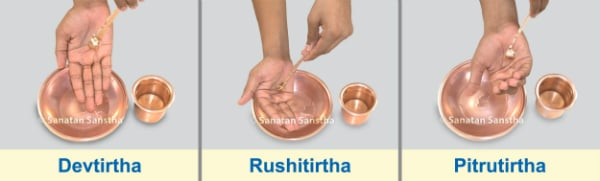
3. As per science, tarpan for God should be performed after doing 'Savya', that for Sages should exist performed after doing 'Nivit' and for deceased ancestors' souls after doing 'Apasavya'.
four. A dried grass twig (darbha) is necessary for performing tarpan. Tarpan for God is performed from the tip of the darbha, tarpan for Sages should be performed by folding the darbha in the middle, and tarpan for deceased ancestors' souls should exist performed from the tip and root of the two darbhas.
5. Offer of water (tarpan) to deities should be washed using the finger tips, while offering of water to Sages should exist done from the base of the little finger and the third finger and that to the deceased ancestors' souls should be done through the mid of the thumb and the start finger of the manus.
6. Tarpan should be performed taking i handful (anjali) of water for each deity, 2 scattering of water for Sages and three handful of water for deceased ancestors' souls. In case of matrutrayi (mother, grandmother and bully grandmother) 3 handful of water should be used and for other females ancestors' souls 1 scattering of water should be used for tarpan.(8)
(Original meaning of discussion 'anjali' is handful ('onjal'). In this context, however, 'giving one handful (anjali) of h2o for tarpan' is to betoken that the tarpan should be given only one time – Compiler)
2.2. Pitru tarpan
A) Meaning
Offering of h2o to deceased ancestors' souls (pitar) is chosen as Pitru tarpan. A Jivatpitruk is not allowed to perform Pitrutarpan.
B) Why should information technology exist done ?
Autonomously from expectation of Pinda and offer of food to priests (Brahmins) from its descendants, the deceased ancestors' souls also look offering of h2o (udak) from them.
C) Importance
By performing tarpan, the deceased ancestors' souls non only go satisfied and get out us, merely they also bequeath long life, radiance, superior intellect (brahmavarchaswa), wealth, success and foodstuff (power to digest the nutrient consumed) on the host performing the tarpan and satisfies him as well.
D)Pitrutirtha
When should it be done?
1. Tarpan for God, Sages and deceased ancestors' souls should be performed regularly (daily). The daily ritual of tarpan should exist accomplished in the early morning after having bathroom. If it is non possible to perform Shraddha for deceased ancestors' souls daily, and so one should at least perform tarpan.
2. Pitru tarpan should be performed on the 24-hour interval post-obit the day on which Parvan Shraddha is performed.
E) Tarpan of sesame seeds (tila tarpan)
Sesame seeds should be used in the ritual of Pitru tarpan. Sesame seeds are available in two varieties, black and white. Black sesame seeds should be used for Shraddha.
i. Tila tarpan means offer sesame seeds mixed in water to the deceased ancestors' souls.
2. Tila tarpan (as a part of Shraddha) should exist offered to the same number of ancestors' souls for whom the shraddha has been performed.
3. Tila tarpan is performed earlier Darsha shraddha and in example of almanac shraddha; tila tarpan is performed on the following day of the shraddha. In case of whatever other shraddha, tila tarpan is performed just subsequently performing the shraddha.
four. Tila tarpan is non performed during Nandi Shraddha, Sapindi Shraddha etc. (nine)
F) Importance of performing tila tarpan
1. Sesame seeds are the favorites of deceased ancestors' souls.
2. On the day of Shraddha, sesame seeds should be sprinkled all over the firm, sesame seeds mixed in water should be given to the invited priests (Brahmins) and sesame seeds should be donated. – Jaiminiya Ghruya sutra (two.one), Boudhayan Dharmasutra (2.viii.8) and Boudhayan Ghruya sutra
Reference : Sanatan'southward Holy text 'Shraddha'

Source: https://www.sanatan.org/en/a/87.html
0 Response to "How To Do Pitru Tarpan At Home"
Post a Comment